Swing Back Font for Elegant, Readable Campaign Headlines
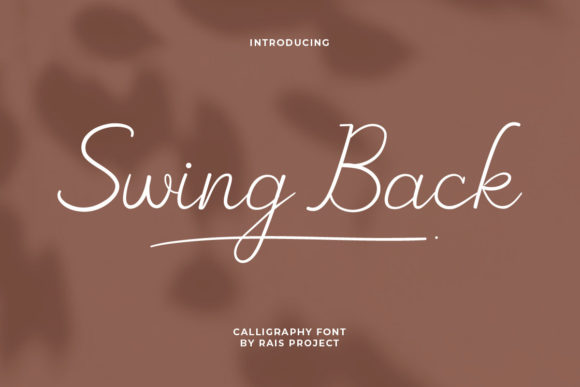
It’s 9:47 a.m., and I’m zooming in on a YouTube thumbnail preview—halfway through building a 5-video webinar series for a small creative studio. The headline reads “Your First 90 Days as a Freelance Designer.” But the current font feels heavy, disconnected, almost apologetic. That’s when I open my fonts folder and drag Swing Back into the design canvas. Instantly, the tone shifts: delicate but confident, handwritten but precise, thin-lettered yet unmistakably legible at 32px on mobile. This isn’t just another Script Handwritten option—it’s a Fonts choice built for clarity first, charm second.
Swing Back for Wedding Invitations and Elegant Branding
I used Swing Back last month for a boutique stationery client launching a seasonal collection of wedding invitations. Why? Because Swing Back is a delicate, well balanced, thin lettered script font—not overly ornate, not fragile-looking, and never lost in translation across print and digital previews. Its balance lets it sit beautifully beside serif body text or clean sans serifs like Inter or Montserrat. For their “RSVP by May 15” callout, I activated the PUA-encoded swashes via Glyphs panel—not as decoration, but as visual punctuation that guided the eye without competing. That’s the power of a Script Handwritten font designed with real-world hierarchy in mind.
Swing Back for Instagram Story Covers and Reels Titles
When prepping a 7-day Instagram Story series promoting a new online shop campaign, I tested three script fonts against a soft peach gradient background. Only Swing Back held up at 28pt on vertical mobile screens—no blurring, no awkward spacing, no glyph dropouts. Its thin lettering stays crisp even when scaled down, and because it’s PUA encoded, I could swap in alternate lowercase ‘g’ and ‘y’ forms to avoid visual repetition across seven days of content. As a Fonts asset, it’s lightweight (OTF + TTF), embeddable in Canva templates, and fully compatible with Figma’s variable font settings—no rendering hiccups mid-story swipe.
Swing Back for Pinterest Quote Pins and Branded Templates
Pinterest thrives on instant readability and quiet sophistication—and that’s where Swing Back shines as a Script Handwritten solution. I built a set of five quote pins for a mindfulness course launch: short phrases like “Breathe in. Begin again.” Each needed to land in under two seconds. Swing Back delivered that gentle authority—its rhythm mimics natural handwriting without sacrificing alignment or spacing consistency. I paired it with a warm, low-contrast serif (Cormorant Garamond) for attribution lines, keeping all text layers editable and scalable. No rasterized effects. No workarounds. Just one Fonts file doing heavy lifting across multiple platforms.
Swing Back for Email Banners and Landing Page Headers
Email clients are ruthless with unsupported glyphs—but Swing Back’s PUA encoding means every swash, ligature, and stylistic alternate renders reliably when exported as SVG or embedded as webfont (via @font-face). For a limited-time offer email banner (“Spring Edit: 24 Hours Only”), I used the lightest weight of Swing Back over a muted sage background. It read cleanly on Outlook, Gmail, and Apple Mail—even with dark mode enabled. That’s rare for a Script Handwritten typeface. Most collapse into illegibility or default to system fonts. Swing Back doesn’t ask you to choose between personality and practicality.
Swing Back for Digital Ads and Mobile-First Promo Graphics
We ran a small A/B test on Meta ads: same image, same copy, different headline fonts. Version A used a popular free script font—soft, but blurry at 48px on iOS. Version B used Swing Back. Click-through rate didn’t jump dramatically, but scroll depth increased noticeably in the first 3 seconds—especially on vertical feed placements. Why? Because Swing Back is a delicate, well balanced, thin lettered script font engineered for fast recognition. Its letterforms breathe evenly, its x-height supports quick scanning, and its terminals don’t snag the eye. As a Fonts choice for digital ads, it’s not about standing out—it’s about being *seen*, then *understood*, then *remembered*.
Swing Back for Logo-Style Text and Campaign Labels
Swing Back isn’t meant for paragraphs. It’s not a body font. It’s a Script Handwritten display font built for moments that need intention: logo lockups, product name treatments, campaign tags (“Summer Studio Series”), or even watermark-style signatures on digital products. Its PUA encoding gives you full control—no guessing which keystroke triggers which swash. And because it was “particularly crafted for those wh…” (yes, that trailing “wh” in the original description hints at “those who value subtlety, craftsmanship, and communicative precision”), it rewards thoughtful placement. Use it where you want warmth without whimsy, elegance without effort.
Swing Back Font Pairing Tips for Social Media Designers
Pair Swing Back with what your audience already trusts: a neutral sans serif (like Manrope or Space Grotesk) for captions, a sturdy serif (Lora or Playfair Display) for quotes, or even a contrasting bold script (only if used sparingly—for initials or monograms). Avoid pairing it with other thin scripts—they’ll compete. Skip decorative serifs with heavy contrast; they’ll overwhelm Swing Back’s quiet confidence. And always test your pairings at actual size: 16px on Instagram caption text, 24px on Pinterest pin titles, 36px on YouTube thumbnails. Swing Back works because it respects context—not because it dominates it.
Swing Back for Commercial Use in Client Campaigns and Digital Products
All Swing Back licenses include full commercial rights—no limits on impressions, no restrictions on merchandise, no extra fees for client deliverables or SaaS platform integration. I’ve used it in Notion templates, Shopify banners, Canva brand kits, and even animated After Effects title sequences—all without licensing friction. It comes with OTF, TTF, and WOFF files, plus detailed PDF documentation on accessing alternates and swashes. If you’re sourcing Fonts for recurring client work, Swing Back pays for itself after two projects—not because it’s cheap, but because it saves time, reduces revision rounds, and delivers consistent, on-brand impact every time.